This summer’s Department for Education Schools, Pupils and their Characteristics release, together with the Independent Schools Council (ISC)’s 2026 census, gave the fullest picture yet of how the independent sector fared in the first full academic year after VAT was introduced on school fees. Three months on – with AY27 now under way and schools already looking ahead to the years beyond it – we think it is worth taking stock of what that data shows, and what it means for schools today.
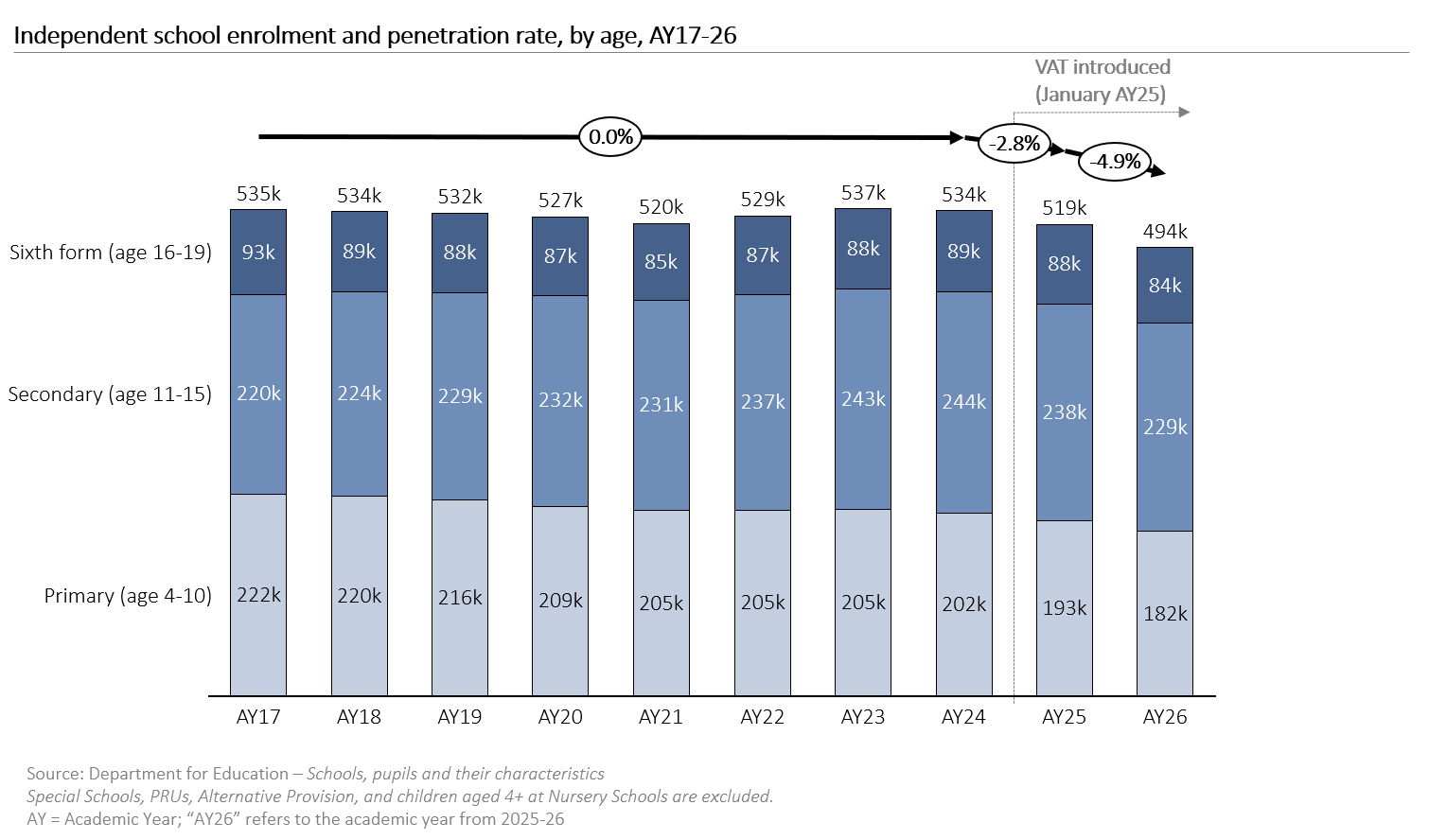
The headline figures are stark: since AY24 – the last full academic year before VAT was introduced on school fees in January 2025 – enrolment at mainstream independent schools in England has fallen by 7.5%, equating to 40,197 fewer pupils. Using ISC’s 2026 average day-school fee of c.£18,700 a year as a proxy, this equates to over £750m of fee income lost from the sector.
Much of the public commentary on this data has, in our view, understated the scale of what has happened. Below, Arun Kanwar and Ali Hinds highlight five key takeaways for schools.
1: Demographics explain only a third of the decline – independent schools are losing share to the state sector across every phase of education
Some media coverage of the enrolment decline has implied it is driven mainly by demographic change, but this is only part of the story. Demographic change has driven a 1.2% p.a. decline in enrolment across all mainstream schools (state and independent combined) since enrolment peaked at 8.55m in AY24. Primary schools have felt this for longer: enrolment of 4- to 10-year-olds has been declining by 0.9% p.a. since AY19, due to lower birth rates, and this effect has now moved up into the senior age range, which has been declining since AY24. The decline is set to continue: the ONS forecasts a 1.0% p.a. fall in the population of 5- to 19-year-olds from 2026-31, with the steepest decline continuing to be in the primary age range.
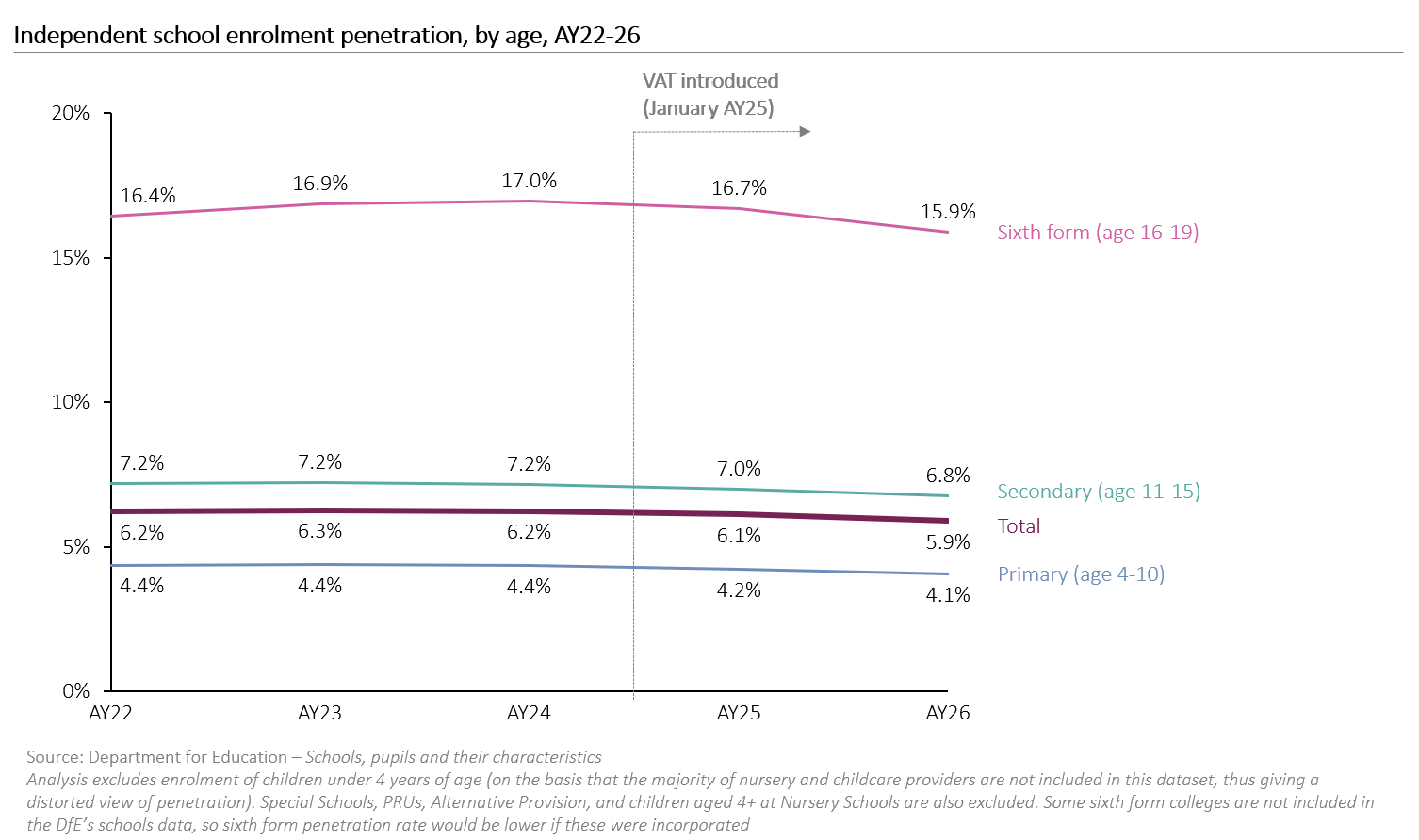
Even against this backdrop of overall decline, independent schools have lost enrolment share since the introduction of VAT. Independent schools held their share of primary and secondary-aged enrolment from AY22-24, at 4.4% and 7.2% respectively, while independent sixth form-aged enrolment gained share over the same period. Since VAT was introduced, however, independent schools have lost share across all three phases of education. Overall, independent enrolment penetration in AY26 stands at 5.9%, down from 6.2% in AY24.
Quantifying this: if independent schools had simply kept pace with the overall enrolment decline of 1.2% p.a. since AY24, this would only account for approximately one third of the actual decline. The remaining two thirds reflects a loss of market share, with the introduction of VAT – and the resulting pressure on affordability – the principal driver, compounded by wider cost-of-living pressures.
2: The pressure is not over – key intake years have been hit hardest, and these smaller cohorts will keep rolling through the system
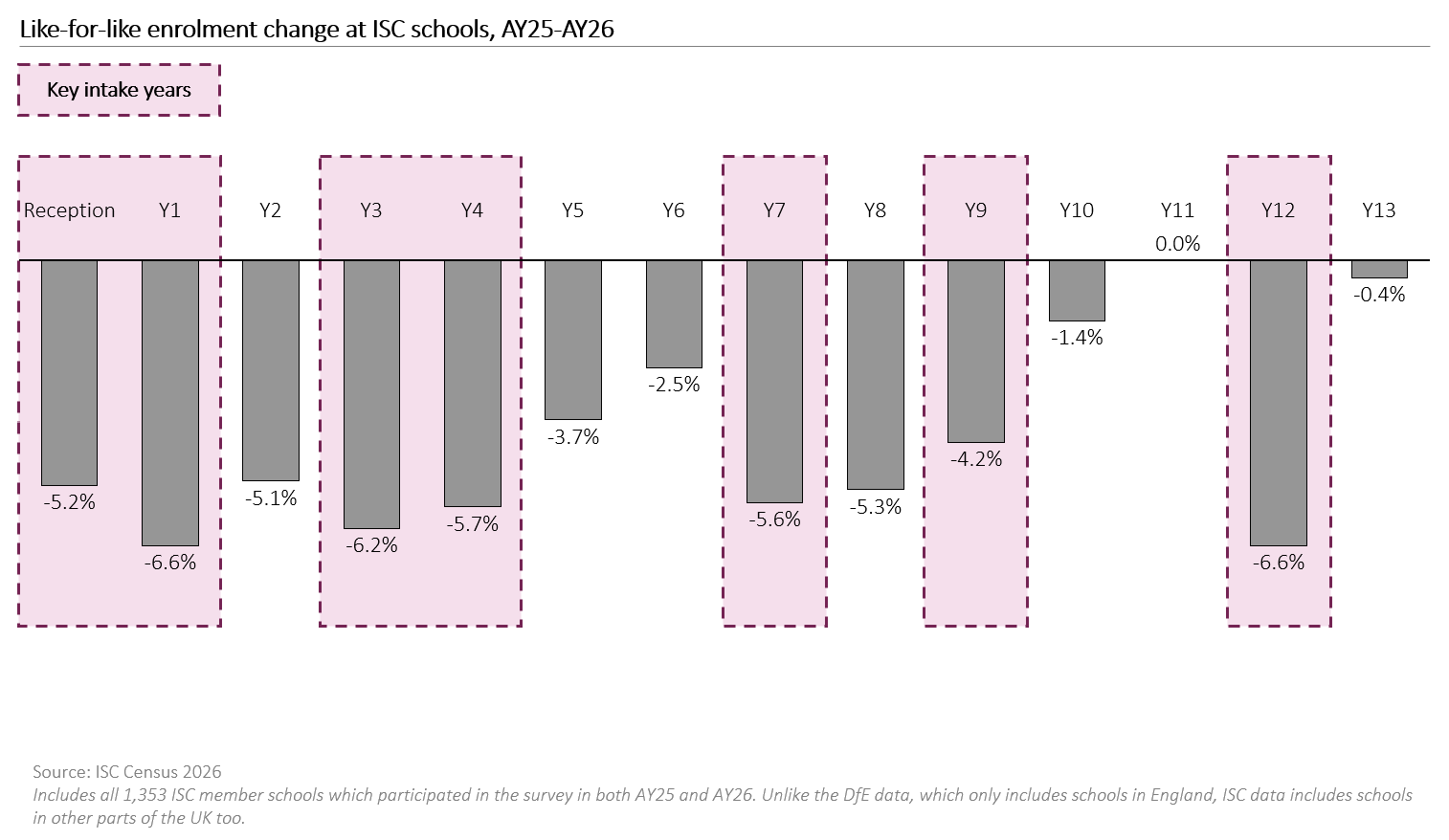
Key intake years have seen a steeper year-on-year decline in enrolment than other year groups, suggesting that existing parents are prioritising keeping their children at their current school until the end of a phase of education, but that new parents are less likely to choose the independent sector, and are more willing to switch out of it at the transition between phases. This will continue to impact independent schools for years to come, as these smaller cohorts roll through the system and larger cohorts age out.
Indicative analysis of the DfE dataset paints a slightly more negative picture for senior and sixth form entry points. Looking only at mainstream schools, the enrolment decline for 11-year-olds (a good proxy for Year 7) was 6.9% at independent schools, versus only 1.9% for state schools. For 16-year-olds (a proxy for Year 12) it was 7.4%, versus 0.4% in the state sector. The gap with the ISC figures is likely because the ISC data excludes the impact of school closures during the year i.e., the ISC sample only includes schools that reported data in both years.
Perhaps the best indicator of the long-term impact comes from the ISC’s data on new joiners: the number of new students joining ISC schools fell 6.1% year-on-year, from c.101k in AY25 to c.95k this year. This is even more striking given it follows a 5.3% decline the year before.
3: The impact has been uneven, with boarding and international pupil numbers falling fastest
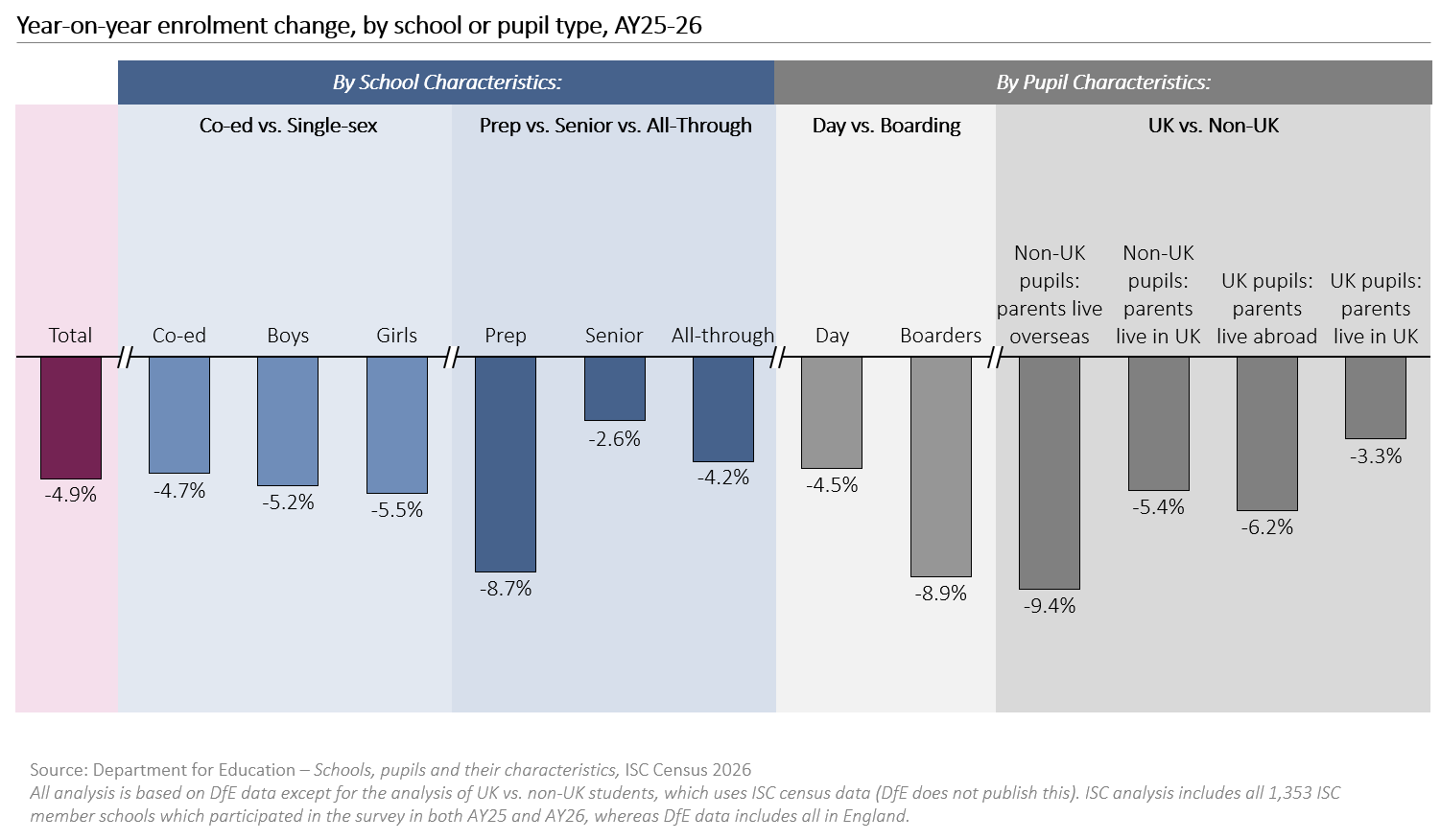
The aggregate decline masks significant variation beneath the surface, with some segments of the market proving considerably more resilient than others.
Co-educational schools appear to have marginally outperformed single-sex schools. However, this is partly driven by struggling single-sex schools converting to co-education to broaden their recruitment pool, thus taking their pupils into the co-ed segment. Conversions to co-education account for around 70% of the fall in all-boys enrolment, and the boys’ schools that stayed single-sex fell by just 2%. Girls’ schools follow a different trend: their continuing schools fell 4.3%, the steepest like-for-like decline of the three segments.
Prep schools fared worst among school types, losing 8.7% of pupils year-on-year – more than three times the rate of senior schools (2.6%). This reflects stronger demographic headwinds at prep age, a higher rate of closures among financially vulnerable prep schools (22 Preps closed in AY26, vs. only 10 Seniors), and some parents prioritising investment in later stages of education.
The sharpest divide is between day and boarding: boarding pupil numbers fell 8.9% in a single year, almost double the 4.5% decline among day pupils. This is closely linked to falling international demand: the number of non-UK pupils whose parents live overseas fell by 9.4% year-on-year. The decline points to a weakening of the UK’s competitive position. High-quality English-medium provision continues to expand globally, giving families more credible options closer to home. At the same time, VAT has narrowed the UK’s traditional price advantage over premium boarding markets such as Switzerland and the US, while strengthening the relative appeal of markets such as Ireland. Uncertainty about the UK’s openness to affluent international families has added to these pressures.
4: Consolidation, not closure, has been the sector’s main response
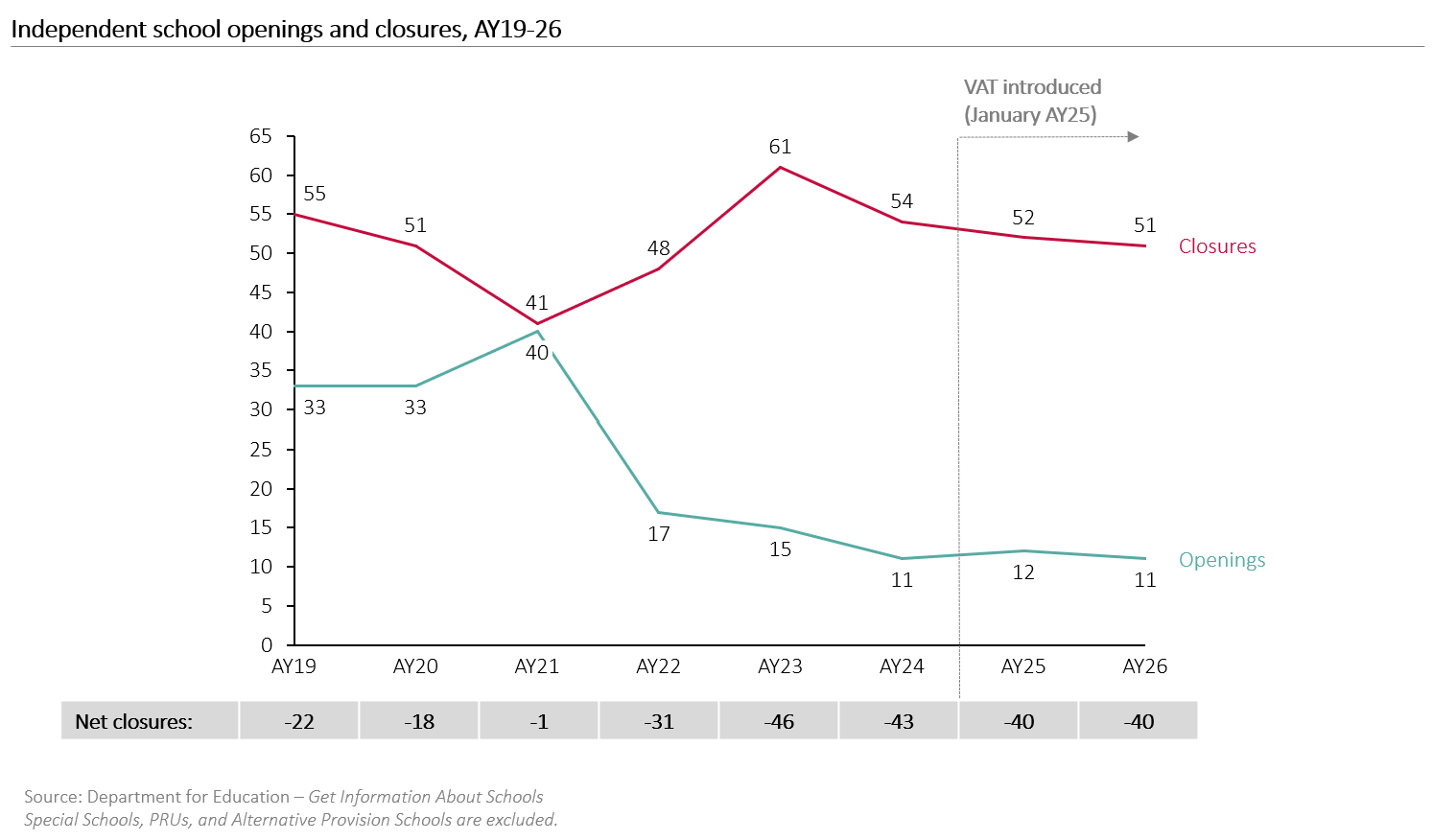
One counterintuitive finding in the DfE data is that closures have not accelerated since VAT was introduced. Around 50 schools per year have closed since AY24, down from a spike of over 60 in AY23, and broadly in line with pre-Covid levels. By contrast, openings have collapsed: over 30 new independent schools opened per year in AY19 and AY20, compared to 11-12 per year from AY24-26. The sector has been losing c.40 schools per year (net) since AY23, roughly double the rate of the late 2010s. It is worth noting that the fall in openings began in AY22, coinciding with Labour’s September 2021 pledge to remove the VAT exemption.
The character of closures has changed, however, even if the number has not. Between AY19 and AY24, the median closing school had 40 pupils; across AY25 and AY26 it had 79. Schools of 200 pupils or more accounted for 7% of closures in the earlier period and 15% since. So, while the number of closures has remained stable, the level of disruption to the sector has certainly increased, as larger and more prominent schools are being forced to close their doors.
Consolidation is a different story: the data shows a clear acceleration, particularly among charitable schools. Grant Thornton report that the volume of not-for-profit (charitable) school mergers rose by 158% in 2025, vs. 104% for all UK independent-school M&A deals. Eastside People’s Good Merger Index found independent schools among 13 of the UK’s 20 largest charity mergers in the year to April 2025, up from 9 the year before and just 1 in each of the preceding years.
But consolidation does not always provide a permanent solution. Some schools that have already been through a merger or change of ownership are closing regardless – one example being Galaxy Global’s recent decision to close Durham High School, Ruthin School, and Malvern St James School. For schools in the weakest financial position, a merger may simply buy time rather than secure a long-term future – delaying, rather than avoiding, an eventual closure. This highlights the importance of proper due diligence to test whether a turnaround is genuinely achievable before embarking upon M&A.
5: Independent special schools are witnessing a boom, as the state sector struggles to accommodate growing demand for SEND support
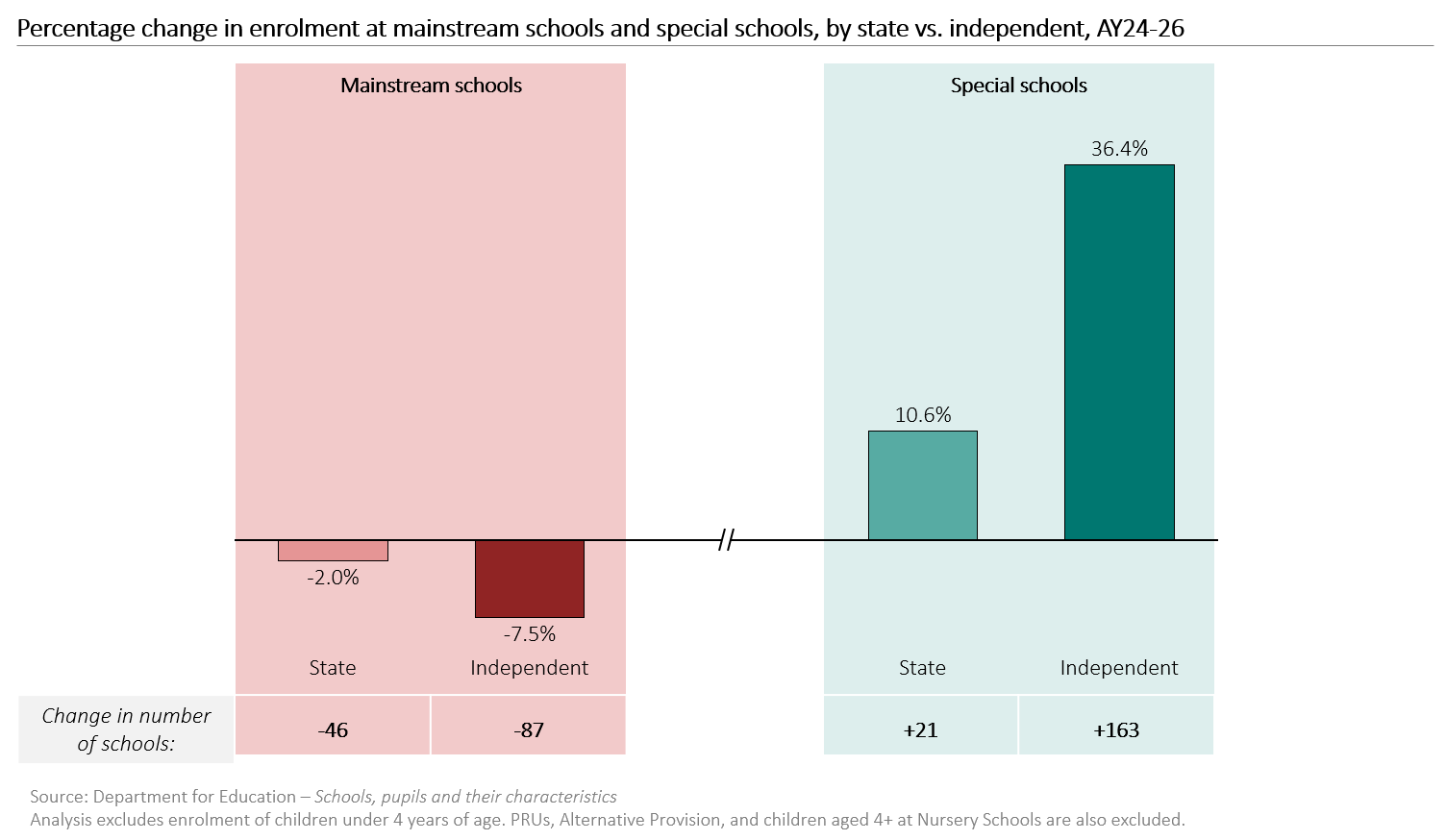
The trends in the SEND/AP market are entirely different to those in mainstream schools – which is why we look at mainstream schools separately from special schools (and other provision such as PRUs and AP) when analysing the DfE data.
There has been a rapid rise in the number of pupils requiring support for special educational needs and disabilities (SEND). While many of these pupils are accommodated in mainstream schools, those with the highest level of need often require a special school place. Children with the highest-acuity SEND needs are given an Education, Health and Care Plan (EHCP) – the number of pupils with an EHCP has grown 9% p.a. since AY17, including 23% growth over the last two years alone. EHCPs are statutory plans that give pupils a legal entitlement to support, and parents have significant influence over which school their child is placed in.
Independent schools have helped meet this growing demand. The number of independent special schools in England has grown by over 160 in the last two years, alongside a c.36% increase in enrolment. State special schools have also grown enrolment by 11% over the same period, but state provision is struggling to keep pace with rising demand, further increasing reliance on independent schools, especially for pupils with the highest levels of need. The impact of VAT on fees is also mitigated: local authorities can reclaim VAT on EHCP placements they fund, while some specialist provision qualifies for exemption where care (rather than education) is the main service supplied.
The government’s recent White Paper (February 2026) sets out a push for more pupils to be educated in mainstream schools, either in mainstream classes or via new on-site resource bases for SEND support. However, there are barriers to this: implementation will take time and investment, and children with the highest levels of need will still require a special school environment. At the time of writing, the Government has yet to publish its response to the consultation, which may reflect the complexity of translating the proposals into practice. Demand for independent special schools is therefore likely to remain strong for the foreseeable future.
What does this mean for school leaders?
How you respond to this data depends entirely on your school’s positioning, and the gap between the two ends of the sector is widening fast. For a meaningful minority of schools, there is a real risk of forced closure or a distressed sale; the sooner that is acknowledged, the more control governors can retain over the outcome. But for others, there is an opportunity to win share, build scale and secure a stronger long-term future.
The worst mistake a school can make is to assume the worst is over, or that a struggling local competitor will close and its pupils will transfer to you. As this piece has shown, it is far more likely to be absorbed into a group, continue to operate, and carry on competing for the same families, often with a stronger balance sheet behind it than it had before.
Every school needs to start from an honest, quantitative assessment of its own position: what is your enrolment trajectory over the coming years as smaller cohorts roll through the school, and is your financial base able to sustain you through these years of pressure? Your position determines which strategic options are still open to you. We see four broad levers available to schools:
The White Paper, “Every Child Achieving and Thriving”, diagnoses the current system as failing on three dimensions: it is not identifying and supporting children’s needs early enough; it is inconsistent and inequitable across local authorities; and it has become financially unsustainable. The proposals are wide-ranging, but three key changes stand out.
- Optimise what you have: are there cost savings available that don’t erode the proposition, is your marketing and admissions function converting as well as it could, and are there weak points in what you offer that – with the right investment – could make you meaningfully more competitive? This lever is increasingly becoming table stakes, and for the most distressed schools, these options may be too little, too late
- Reconfigure your offer: could you extend phases to become an all-through school, rethink your boarding offer, move to co-education, or reposition entirely (for example, towards SEND provision, where demand is growing fastest)? The available options depend not only on your school’s current offering, but also how much capital you are able to invest – e.g., a prep school cannot simply expand into senior unless it can offer competitive facilities to support the change
- Diversify your revenue streams: could you extend into nurseries, international campuses or license agreements, summer camps, language schools, or make wider commercial use of your estate? We have seen many schools execute these strategies successfully, with nurseries in particular underpinning the financial performance of some schools and groups. However, these are genuinely different businesses and thus can place significant demands on leadership, and like the reconfiguration options above, require investment
- Consider M&A: an option from a position of strength or weakness alike. It can be defensive (e.g., a senior school merging with a feeder prep to prevent a competitor from doing so and channelling that feed into its own); expansionist (building a group to create a more integrated pupil journey, or reach new geographies and propositions); or a route for a weaker school to gain the protection of a stronger brand and balance sheet. As highlighted above, boards on both sides of a transaction should conduct due diligence to test whether a turnaround is viable before committing – including in charitable mergers, where no money changes hands but the risk and liabilities transfer all the same
Arun Kanwar (Partner), and Alison Hinds (Principal), authors of this article.
If you would like to discuss the content of this article further or learn more about our work, contact the authors directly or at [email protected].