England’s special educational needs and disabilities (SEND) system has been under intensifying public scrutiny. The number of children holding an Education, Health and Care Plan (EHCP) — the statutory document that secures specialist support for children with the most significant needs — has more than doubled over the past decade, placing enormous strain on local authority budgets, mainstream schools and the specialist sector.
Against this backdrop, the government published the SEND White Paper, “Every Child Achieving and Thriving”, on 23rd February 2026, followed by a consultation that ran until 18th May. The proposals lay out a significant structural reform of the SEND framework. In this thought piece, we draw on the latest data and the White Paper’s proposals to assess the likely implications for independent specialist providers — weighing both the commercial risks and the opportunities these changes could bring.
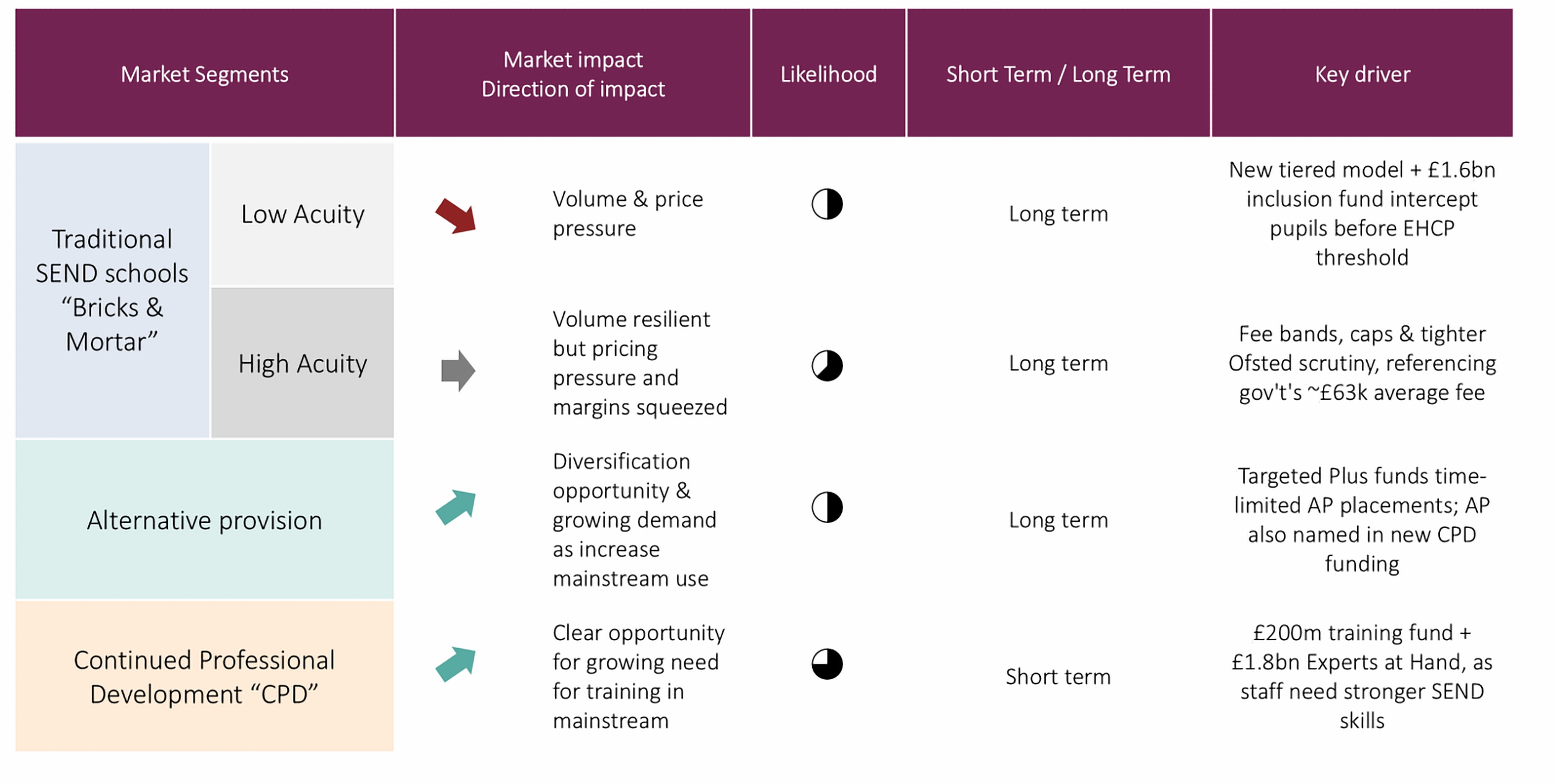
For independent special schools, the fundamental risk emerging from the White Paper is pressure on pricing and not a risk to volumes. Demand for placements continues to grow rapidly, and although the reforms aim to reduce EHCP numbers and reliance on specialist schools, we believe independent providers are unlikely to see volumes fall, at least in the medium term. Higher-acuity placements should prove particularly resilient, as reforms target moderate- and lower-acuity needs — but tighter fee bands and stronger oversight from Ofsted (the Office for Standards in Education, Children’s Services and Skills) look set to squeeze margins instead. The White Paper also opens a real diversification opportunity resulting from the £2 billion of new government funding for continuing professional development (CPD) and the ‘Experts at Hand’ service.
What is the White Paper proposing?
The White Paper, “Every Child Achieving and Thriving”, diagnoses the current system as failing on three dimensions: it is not identifying and supporting children’s needs early enough; it is inconsistent and inequitable across local authorities; and it has become financially unsustainable. The proposals are wide-ranging, but three key changes stand out.
- A new tiered model of support & Individual Support Plans (ISPs)
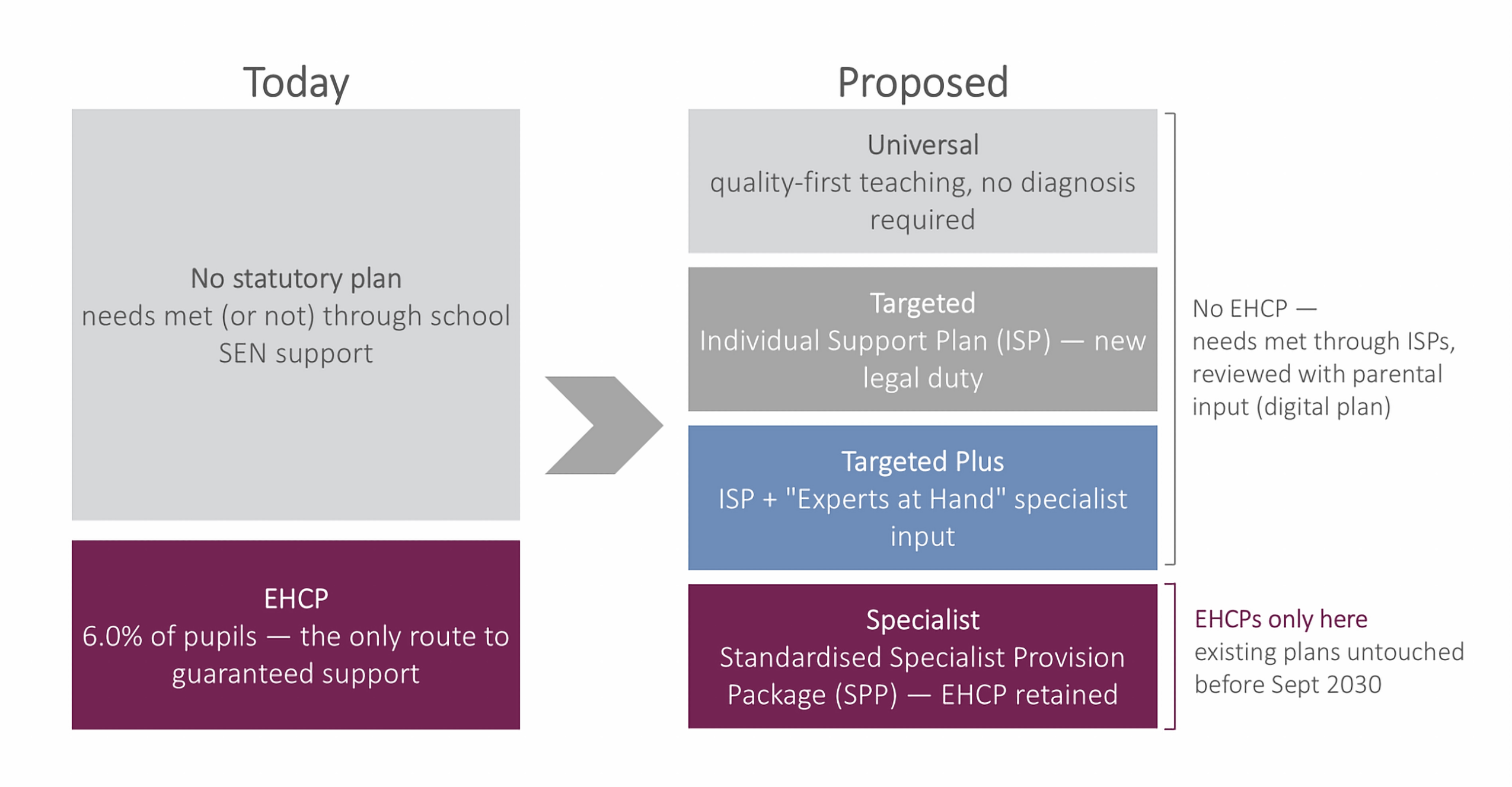
The current binary system — special educational needs (SEN) support or EHCP — would be replaced by a four-tier structure.
- Universal offer: all pupils, no SEND diagnosis required
- Targeted: structured support within mainstream settings
- Targeted Plus: access to specialists (educational psychologists, speech and language therapists, occupational therapists) via a new “Experts at Hand” service
- Specialist: standardised Specialist Provision Packages (SPPs) for children with the most complex needs. Only children with SPPs will be eligible for EHCPs, and not all will have one
Every child with a special educational need — not just those with EHCPs — would be given a digital ISP, reviewed annually and produced with parental input. Schools, nurseries and colleges would be under a new legal duty to create these plans for every child with a special educational need.
2. New controls on independent special schools
The White Paper explicitly frames the growth of Independent Special School (ISS) placements as a system failure and proposes a raft of new controls:
- Banded funding and capped fees for all ISS placements
- A requirement for ISS to offer placements based on standardised SPPs and to report costs to commissioning councils.
- New Ofsted inspection standards aligned with those for maintained schools, including an Inclusion Strategy requirement.
- The Education Secretary would gain the power to refuse the expansion or opening of new ISS where there is insufficient evidence of commissioning demand.
3. Significant investment in mainstream inclusion, and ‘Experts at Hand’ services
Alongside the structural reforms, the government outlined significant investment including a £1.6 billion fund to support mainstream settings develop their ability to cater for more pupils with SEND over the next three years, such as funding the ability to run targeted and small group interventions at the earliest signs of additional needs. The reforms are also underpinned by a new £1.8 billion fund which will be deployed over three years (2026-2029) to create the “Experts at Hand” service, giving mainstream schools direct access to educational psychologists, speech and language therapists and occupational therapists without requiring an EHCP. A further £200 million has been allocated to a new national SEND training programme for all teaching staff, to be delivered flexibly through online and in-person formats.
 Risks and Opportunities: What does this mean for independent special schools?
The White Paper is a statement of policy intent, not legislation; the path from publication to statute will require Parliamentary time and is subject to amendment, with some watering down likely. Even if the proposals are approved in full, full implementation is not expected before September 2029, and the rapidly increasing number of EHCPs in England is expected to continue for at least the next four years. Additionally, the government is yet to publish their response to the consultation that concluded in May, highlighting the complexity of these reforms. Nevertheless, the direction of travel is clear: the government is seeking to a) better equip the education system to identify and educate children with SEND; b) move more children with SEND into the mainstream public sector and reduce the over-reliance on specialist settings; and c) increase scrutiny and limit the pricing power of independent special schools.
The overarching intent of the reforms is to ensure more children with special needs can be catered for in mainstream education. Whilst this could mean fewer children are likely to receive EHCPs and more will be supported through lower tiers, the reforms focus particularly on moderate-need children; higher-acuity placements are likely to be relatively less affected and consequently the need for independent special schools is unlikely to fade.
Therefore, it is less a question of volume for independent special school operators in the medium term than one of potential limits on pricing power. The government has noted a £63,000 average for independent special schools, and there is indication that this is a figure the government will use to inform fee bands for independent special provision. Providers have highlighted that this approach is a massive simplification of ISS fees and costs will need to vary by region and by the unique needs and level of acuity each setting serves, but nonetheless are already feeling the pricing pressure from local authority commissioners. As a result of this providers will need to demonstrate the quality of care they deliver, both in outcomes for pupils and proving care is delivered as efficiently as possible to prove value for money.
Whilst price capping will place pressure on independent operators and bring significant challenges to ensure quality of care does not slip, the White Paper also brings several diversification opportunities. The reforms create a structural tailwind for the SEND CPD market. If more children with complex needs are to be educated in mainstream settings, teachers and support staff will require significantly enhanced skills. The ‘Experts at Hand’ service, supported by £1.8 billion of funding, which is to be deployed over the next three years, alongside the new £200 million training programme for SEND CPD, provide exciting short–term opportunities for independent special schools and alternative provision providers to offer their expertise in therapeutic approaches, trauma–informed education and handling a wide range of acuity levels to the state sector. However, the limited supply of speech and language, occupational and educational therapists could be a constraint on this roll-out. Beyond this, diversification opportunities exist for SEND providers including internationalisation, expanding into Alternative Provision, and online or hybrid schools.
Why volumes are unlikely to be a concern for Independent Special Schools in the medium term
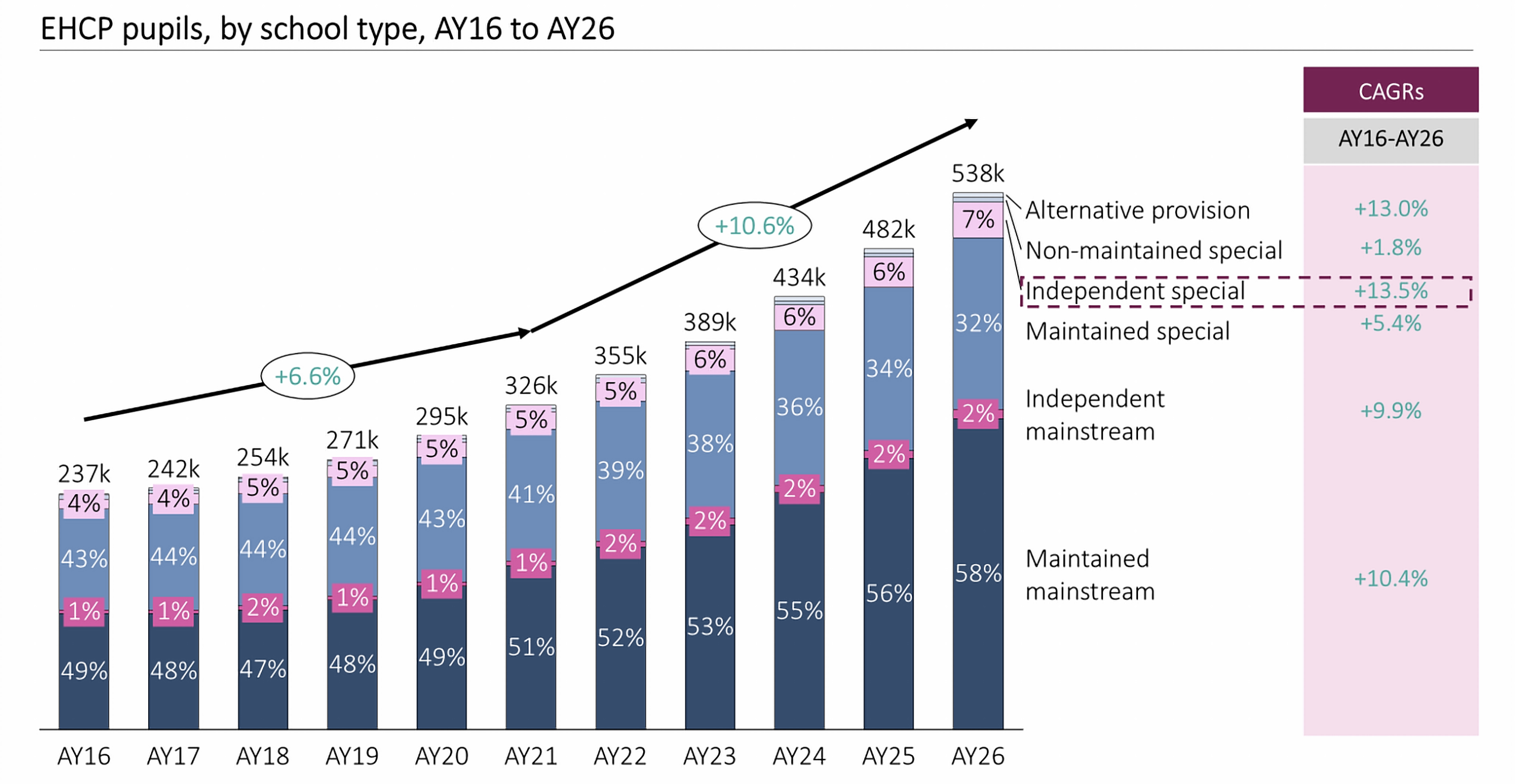
The rapid growth in the number of children in England with an Education, Health and Care Plan has continued, and the recent release of the latest academic year (AY26) data confirms that this trend has accelerated. Between AY16 and AY21, prior to the impacts of the pandemic, the number of EHCPs grew by 6.6% per annum; since AY21, EHCPs have grown at a staggering 10.6% per annum, reaching a total of 538k school-age children with EHCPs in AY26 — an 11.6% increase on AY25 figures. Proportionally, 6% of the pupil population now carries an EHCP, up from just 2.8% in AY16.
How does the DfE expect the reforms to impact the number of children with EHCPs?
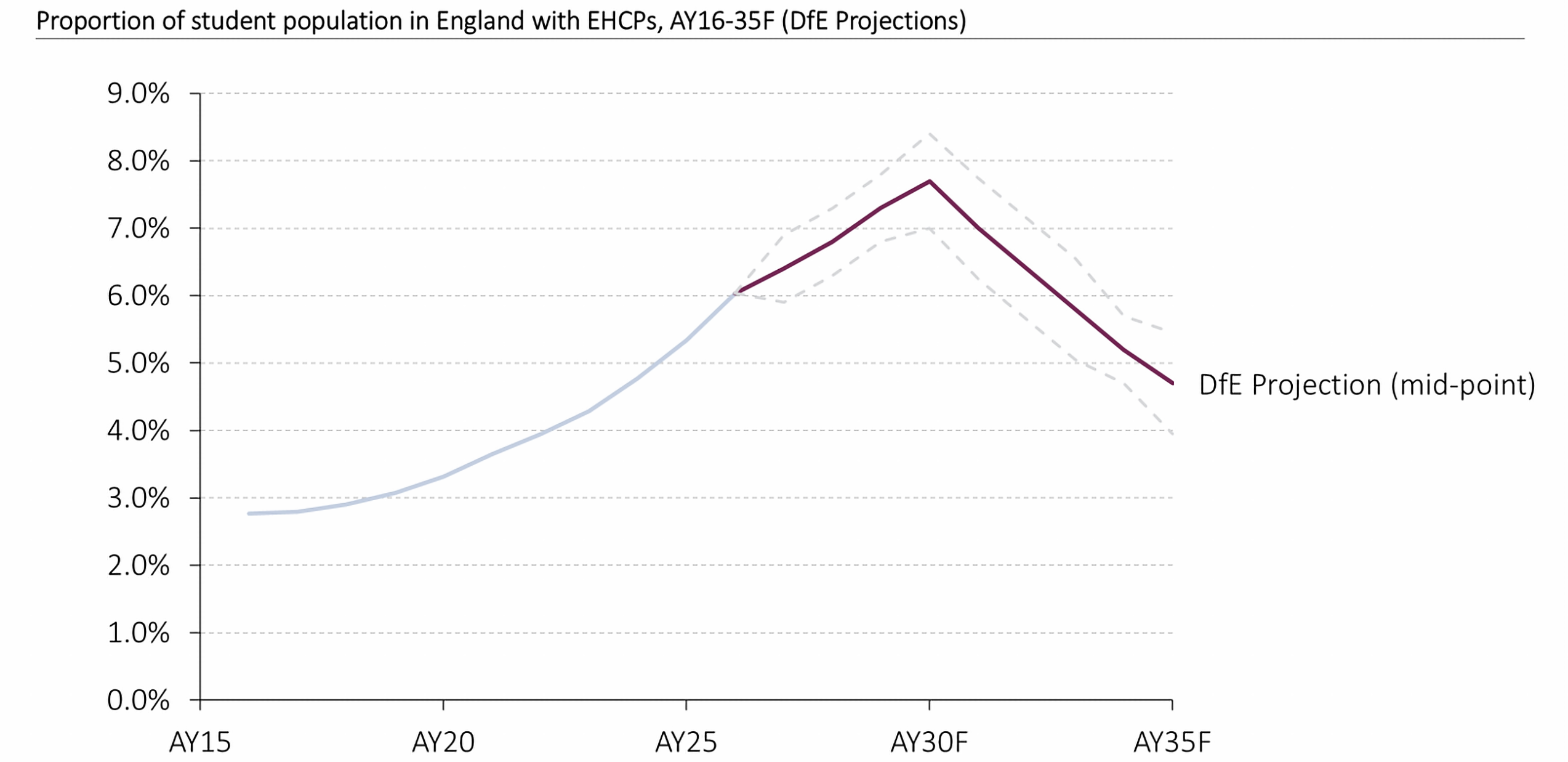
The Department for Education’s (DfE) own projections show a continued growth in EHCPs and undercut any near-term volume concern. EHCP prevalence is set to keep rising for the rest of the decade, reaching a peak of 7.7% of school pupils in 2029/30 (AY30) — up from 6.0% in AY26 — at the very point the new system is assumed to be fully in place. Critically, the DfE is explicit that while investment in early intervention slows the rate at which new EHCPs are issued, the absolute number and proportion of children with a plan keeps growing throughout this period: demand for placements has further to run before any reform effect can bite.
Only from 2030/31 does the DfE expect EHCP prevalence to begin declining, and even then, only gradually — falling year-on-year to 4.7% by 2034/35, a proportion roughly in line with AY24 levels, reinforcing why volume is unlikely to be a significant risk for independent providers. The DfE also projects only a marginal change in ISS penetration. The proportion of all school pupils placed in ISS is expected to peak at 0.5% in AY28, before easing back to 0.4% (the same level as today) and holding there through to AY33; only in AY34 does it dip to 0.3%. Instead, the DfE expects growth in specialist provision to come mainly from specialist bases within mainstream schools, rising from 0.3% to 0.8% of pupils by AY31, and to a lesser extent from state-funded special schools (1.9% to 2.1%). On the DfE’s own figures, therefore, demand for independent places is unlikely to fall materially in the medium term.
Conclusion
The SEND White Paper represents a genuine and ambitious attempt to address a system that has been under acute strain for a decade. Yet the task is hugely complex: we understand the government’s response to the consultation has been delayed precisely because any solution must balance children’s needs, state and independent capacity, and the capital investment required. That complexity makes further delay, and some dilution of the proposals, likely. In the medium term, therefore, the impact on the rapid growth in the number of children with SEND and EHCPs requiring specialist care is likely to be limited, and the demand for independent special schools will likely continue to rise as local authorities continue to struggle to place every child with these needs. However, price caps and increased scrutiny on independent providers will cause challenges for many operators, especially those serving the highest levels of acuity — the very segment whose volumes look most secure, but whose cost bases sit furthest above any banded average, and who will need to demonstrate value for money to defend their fees. At the same time, the reforms introduce new funding streams that give independent providers a near-term opportunity to put their existing expertise to work, supporting the ‘Experts at Hand’ service and diversifying into CPD for mainstream schools.
Arun Kanwar (Partner), and Sam Tansey (Manager), authors of this article.
Our SEND practice is led by Arun Kanwar (Partner), Sam Lecacheur (Partner), Alison Hinds (Principal), Sam Tansey (Manager).
If you would like to discuss the content of this article further or learn more about our work, contact the authors directly or at [email protected].